
We have all been there. It is Sunday evening, and you are feeling highly motivated. You download one of the most popular calorie-tracking apps, input your goal weight, and meticulously log every single gram of your meal prep for the week. For the first few days, you feel completely in control. You are hitting your macronutrient targets, staying within your calorie deficit, and feeling proud of your discipline.
But fast-forward to day fourteen. You are out to dinner with friends, staring at a plate of complex, mixed ingredients. You pull out your phone, open the app, and type in “chicken salad.” Suddenly, you are confronted with 400 different search results. Which one is it? Did the chef use olive oil or butter? How many grams of feta cheese is that?
The frustration mounts. You close the app, tell yourself you will guess later, and ultimately forget. The next day, feeling guilty about missing a log, you skip tracking your breakfast. By the weekend, the app is just another unused icon taking up space on your home screen.
If this cycle sounds familiar, you are not alone. You are experiencing calorie counting fatigue, and it is the number one reason why people abandon their nutritional goals. The hard truth is that traditional calorie counting apps are fundamentally flawed. They rely on outdated, high-friction methods that actively ruin your diet consistency.
Here is why manual food tracking is holding you back, and why the easiest way to track calories is no longer a search bar—it is your camera.
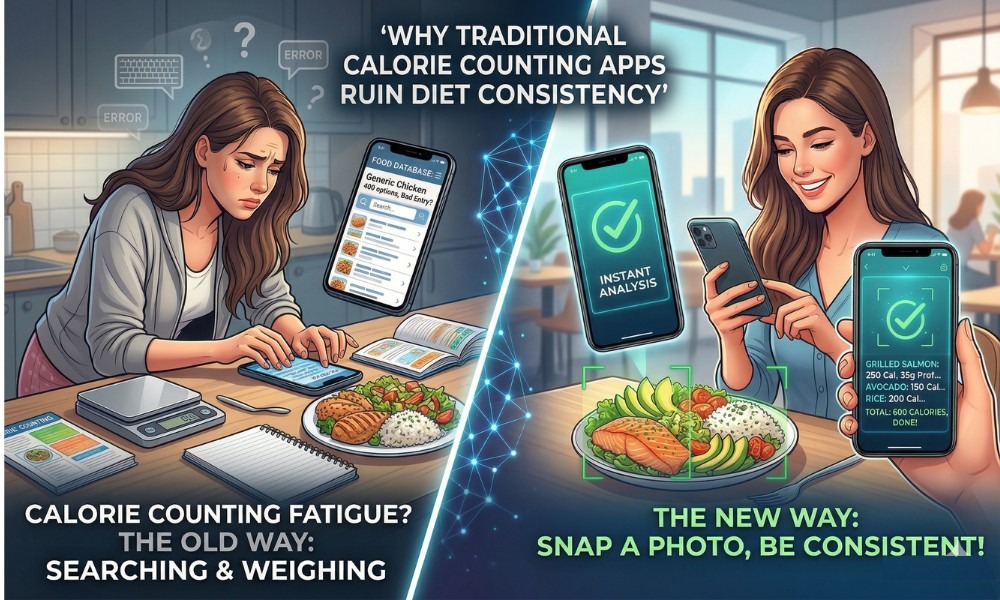
The Anatomy of Calorie Counting Fatigue
Diet consistency is the undisputed king of weight loss and metabolic health. Whether you are trying to shed fat, build muscle, or manage a condition like diabetes, doing something “pretty well” for a year will always yield better results than doing something “perfectly” for two weeks.
Traditional tracking apps demand perfection. They act as demanding digital accountants, requiring constant, tedious data entry. This creates immense psychological friction. Let’s break down the specific elements that contribute to calorie counting fatigue.
The Database Dilemma
Most traditional apps rely heavily on crowdsourced databases. While this means they have millions of foods listed, it also means the data is notoriously inaccurate. When you search for a generic item like “avocado toast,” you are relying on the nutritional estimates entered by a random user three years ago.
This forces you to become a dietary detective. You find yourself cross-referencing packaging with app data, adjusting serving sizes, and scrolling through endless variations of the exact same food just to find one that seems somewhat accurate. This process transforms a simple meal into a homework assignment.
Portion Size Paralysis and the Kitchen Scale
Manual tracking essentially chains you to your digital kitchen scale. If you want accurate data in a traditional app, you cannot just log “one apple.” You need to know if it is a 120-gram apple or a 180-gram apple.
While weighing food is a great educational tool initially, it is completely unsustainable for the average person long-term. Measuring every splash of milk in your coffee, every teaspoon of olive oil in your pan, and every gram of protein on your plate is exhausting. It turns the joyful act of cooking and eating into a sterile, clinical process. When weighing becomes too much of a hassle, users start eyeballing their portions, leading to massive inaccuracies and stalled progress.
The Social Friction of Tracking
Perhaps the most damaging aspect of traditional calorie counting apps is how they function in the real world. Real life does not happen in a perfectly measured kitchen. It happens at restaurants, family barbecues, and spontaneous office lunches.
Trying to manually log a restaurant meal is an exercise in futility. Because you cannot weigh the ingredients, you are forced to deconstruct the meal visually, guess the weights of each component, search for them individually, and hope for the best. Not only is this wildly inaccurate (frequently missing hidden calories in cooking oils and sauces), but it is also socially isolating. Nobody wants to be the person ignoring their friends at the dinner table while frantically typing into their phone for ten minutes.
Why “Perfect” Tracking is the Enemy of Consistency
The psychological toll of this constant friction cannot be overstated. Willpower is a finite resource. Every time you have to force yourself to search a database, weigh a macro, or guess a restaurant meal, you are draining your daily willpower reserves.
This leads to the “all-or-nothing” mentality. Traditional apps condition us to believe that if a day isn’t perfectly logged, the day is ruined. This perfectionism is toxic to consistency. Missing one meal log creates a cascading effect: you skip the whole day, which turns into skipping the weekend, which results in abandoning the diet entirely.
The tool that was supposed to help you achieve your goals becomes a source of guilt and anxiety. You don’t need a stricter diet; you need a system with zero friction. You need the easiest way to track calories—one that integrates seamlessly into your life without demanding constant data entry.
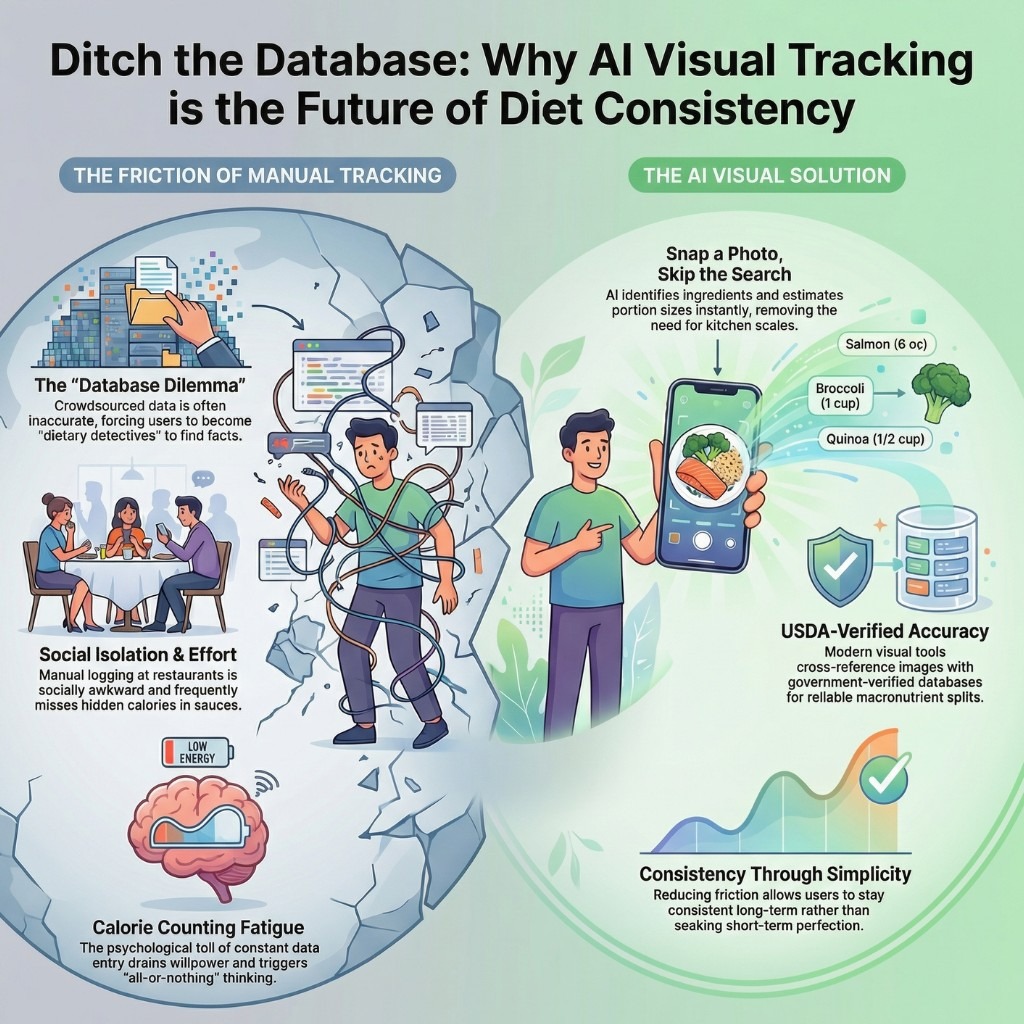
The Easiest Way to Track Calories: Welcome to the Visual Era
If the problem with diet tracking is the friction of manual data entry, the solution is to eliminate the data entry entirely. We are currently experiencing a paradigm shift in health technology, moving away from the keyboard and toward the camera.
Thanks to advancements in Artificial Intelligence and Computer Vision, the days of searching databases and weighing ingredients are coming to an end. The modern approach to nutrition tracking can be summarized in three words: Snap a photo.
How AI Food Scanners Change the Game
Imagine sitting down at a restaurant. Your meal arrives. Instead of opening an app, searching for five different ingredients, and guessing the weights, you simply open your camera. You snap a clear photo of your plate, and within seconds, an AI algorithm analyzes the image.
It recognizes the grilled chicken breast, identifies the side of quinoa, and spots the vinaigrette on the salad. It then cross-references this visual data with highly accurate, government-verified databases (like the USDA FoodData Central) to instantly generate your macronutrient split—calories, protein, fats, and carbohydrates.
This is not science fiction; this is the reality of modern dietary tracking, and it completely cures calorie counting fatigue.
Eliminating the Friction Points
When you transition to an AI-powered photo scanner, the roadblocks that used to ruin your consistency disappear overnight:
- Zero Data Entry: You never have to type the word “banana” into a search bar ever again. The visual recognition handles the identification instantly.
- No More Guessing Games: Advanced AI doesn’t just identify the food; it estimates the volume and portion size relative to the plate, giving you a highly educated estimate without needing a digital scale.
- Socially Seamless: Taking a quick photo of your food is incredibly common in today’s culture. It takes two seconds, doesn’t interrupt the conversation, and allows you to enjoy your meal while the AI does the heavy lifting in the background.
Consistency Through Simplicity
The ultimate goal of tracking your nutrition is to build awareness and make better choices, not to become a slave to a spreadsheet. Whether you are a weight-loss warrior trying to uncover hidden calories, a Keto dieter managing strict net carbs, or a biohacker correlating meals with continuous glucose monitors, the quality of your data matters.
However, high-quality data is useless if the method of acquiring it makes you want to quit after two weeks. By removing the friction of manual searches, inaccurate crowdsourced databases, and obsessive food weighing, AI visual tracking allows you to stay consistent. It bridges the gap between knowing what you should do and actually doing it long-term.
Take Control of Your Nutrition Today
It is time to stop letting clunky, outdated apps dictate your relationship with food. If you are tired of the daily data entry grind, it is time to upgrade your toolkit.
At NutrientsCalculator.com, we believe tracking your diet shouldn’t feel like a second job. Our free, web-based tool uses advanced Vision AI to instantly analyze the nutritional value of your meal directly from a photo. There are no apps to download, no accounts to create, and no confusing databases to navigate. Just highly accurate, USDA-verified macronutrient breakdowns in seconds.
Ditch the food scale, beat calorie counting fatigue, and discover the easiest way to track calories today. Snap a photo of your next meal and let the AI do the rest.